Capability · Approval gate
Propose → approve → dispatch. Default-deny.
Default-deny control: mutation-capable tool calls become pending proposals and wait for your decision before anything is dispatched.
monopea never lets an agent act outward on its own say-so. Every mutation-capable tool call — send the email, update the record, move the money — is drafted as a proposal: the exact tool, the exact arguments, held in a pending state while the run blocks and waits for your decision.
That is the whole architecture in one sentence: propose → approve → dispatch. The agent plans and drafts at machine speed; outward execution happens only after a human decision — or under a policy you granted explicitly, on the record, in advance.
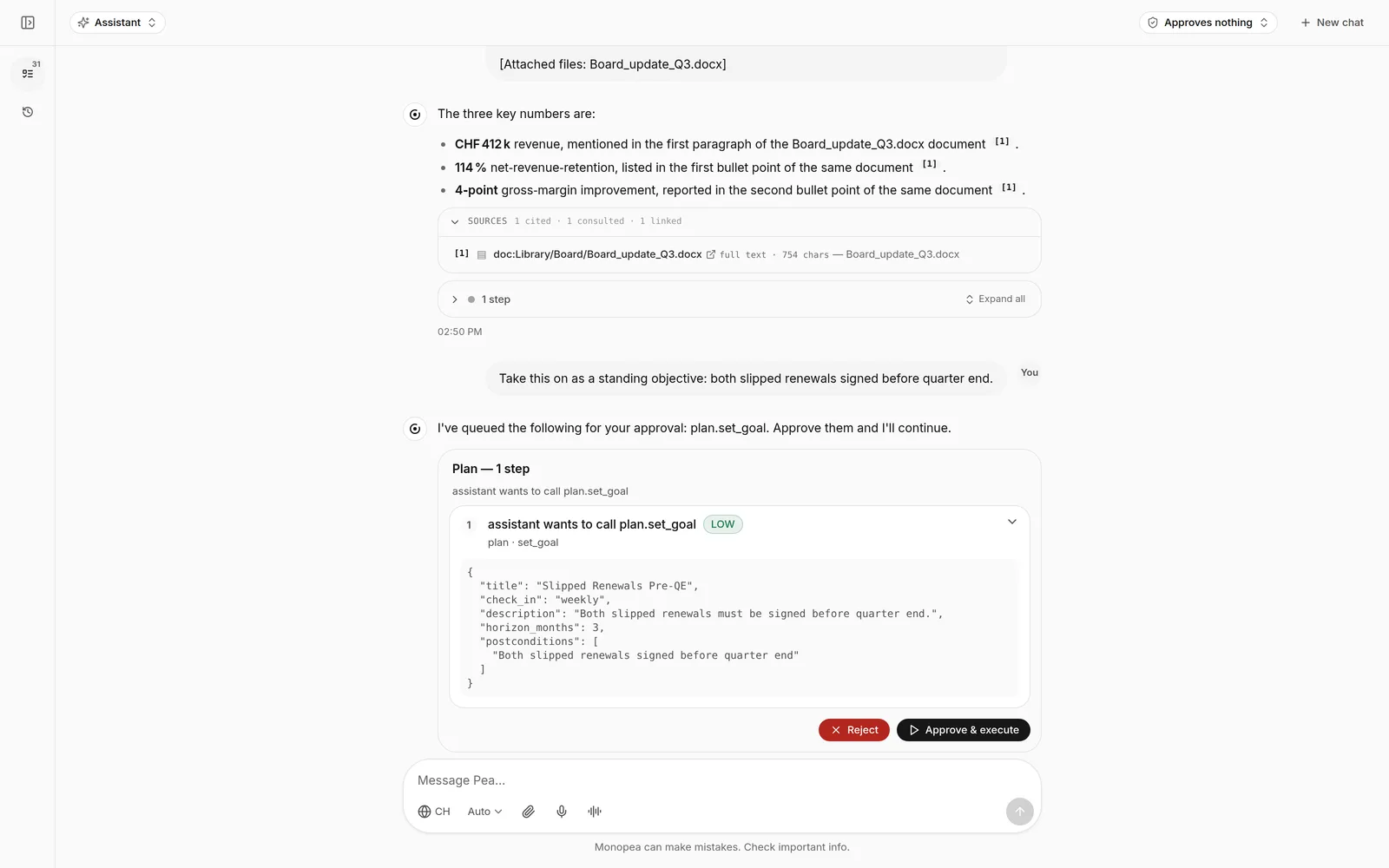
01 / MECHANISM
How the propose → approve → dispatch lifecycle works
When the agent decides an action is needed, it does not execute the call. It writes a proposal — tool name, full arguments, context — and the run enters a blocked state until you approve or reject it. Only an approved proposal is dispatched, and every step of that lifecycle is logged.
You see exactly what would run before it runs. Approve, and the call dispatches immediately; reject, and the agent takes the feedback and re-plans. There is no third path where an ungated action slips through: a call either matches a policy you granted or it waits for you.
- The agent drafts the exact call — tool and arguments — before anything runs
- The run blocks until you decide; approval is what dispatches the call
- Rejections feed back into the plan instead of failing silently
02 / MECHANISM
Why default-deny is the right default
Most agent frameworks execute tools by default and rely on prompt instructions to behave. monopea inverts that: dispatch is denied unless a decision or an explicit policy allows it. A tool the platform has never evaluated fails closed — its calls route to review automatically, because unknown should never mean allowed.
The gate lives in the runtime, not the prompt. A system-prompt instruction can be argued out of by a clever input; an architectural gate cannot. Whatever model you run — Claude, GPT, or a Swiss-hosted open-weight model — the same gate sits between it and your tools.
03 / MECHANISM
Raise autonomy deliberately, one threshold at a time
Default-deny does not mean approving everything forever. Every tool carries a risk level — NONE, LOW, MEDIUM, HIGH, CRITICAL — and you set the highest level allowed to run unattended. Calls at or below the line dispatch without a pause; everything above it still waits for you. You set that line for the workspace, and you can set a different one for a single project.
In practice, autonomy expands at the pace of your confidence. Week one the line sits at NONE and everything stops for review. By week four the routine, low-risk plays flow while anything novel or sensitive still waits. Moving the line is itself recorded — who moved it, from what to what — so the agent gets faster without your exposure growing silently.
- One risk threshold, set per workspace and overridable per project
- Every change is recorded with who made it and how far it moved
- Sensitive and unknown actions keep stopping for you
04 / MECHANISM
Built for EU AI Act Article 14 oversight
Article 14 of the EU AI Act, enforceable since August 2026, requires effective human oversight of high-risk AI systems — oversight implemented as a real control, not a suggestion in a prompt. monopea’s proposal gate is exactly that kind of control: external to the model, enforced by the runtime, and evidenced in logs.
Every proposal, approval, rejection, and dispatch is written to the audit trail, and audit-chain checkpoints are Ed25519-signed so the record is tamper-evident. monopea was built for this oversight model — that is an architectural fit, not a certification claim.
Why it matters
What it changes in practice.
01
No surprise actions
Outward actions are drafted and held, not fired. You see the exact call before it exists in the world.
02
Autonomy on your terms
Raise the risk threshold for the plays you trust; everything else keeps stopping for you.
03
Unknowns fail closed
A tool the platform has not evaluated routes to review by default. Unknown never means allowed.
04
Evidence, not assurances
The full decision history is logged and Ed25519-signed, so oversight is provable after the fact.
FAQ
Approval gate, in short.
What happens when the agent wants to do something risky?
Does every single action require my approval?
What happens with a tool Monopea has never seen?
Is this EU AI Act Article 14 compliant?
Is the approval history verifiable?
Keep exploring
Secrets vault
A write-only vault: the agent references {{secret:NAME}}, the plaintext is substituted only at dispatch, and the model never sees the value.
ReadAudit trail & live activity
Every proposal, decision, and dispatch on a signed, tamper-evident record — with a live view of what is running right now.
ReadDelegation & sub-agents
Big jobs fan out to sub-agents that run in parallel — every one of them inheriting the same approval gate, and all of them stoppable at once.
ReadStart with everything gated. Open it up as you go.
Open a workspace, give the agent a task, and approve what it proposes. Stored in Switzerland, processed in the EU.