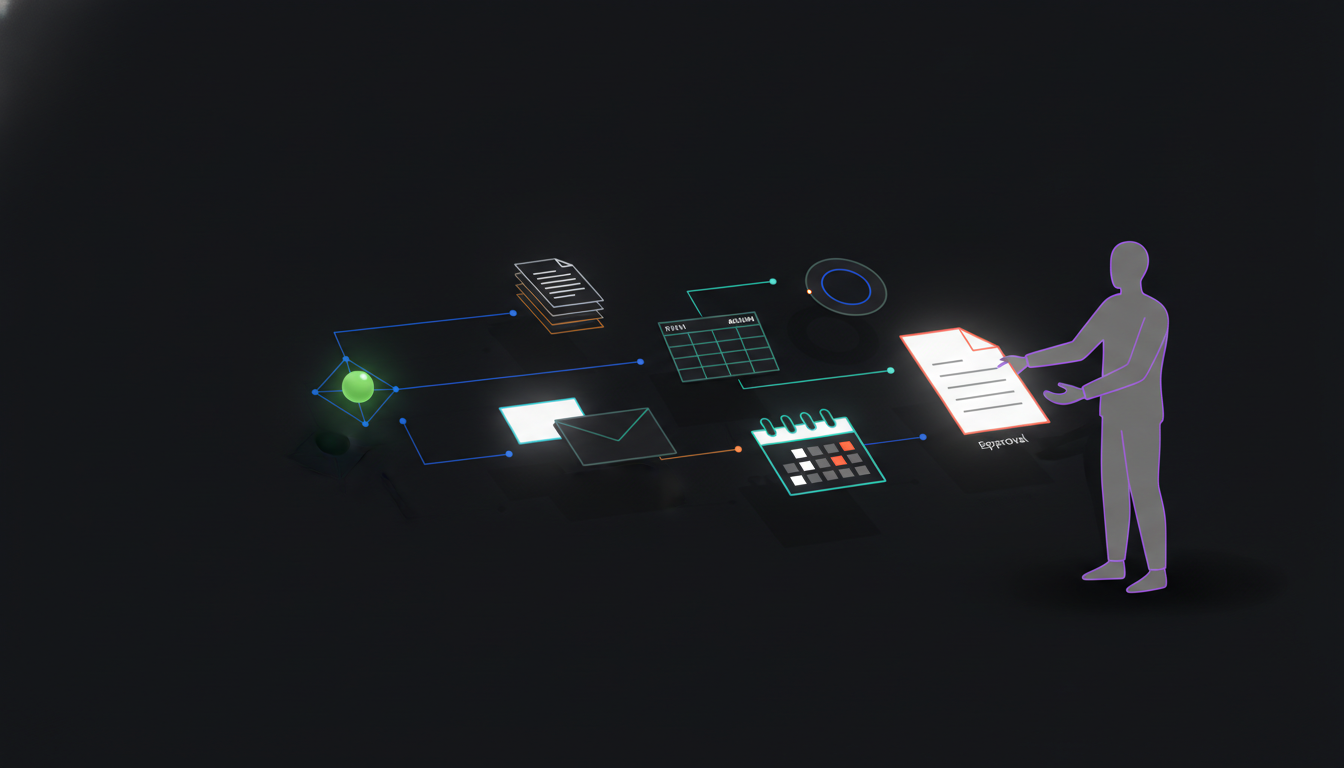
An AI Chief of Staff is a governed agent that manages commitments, briefs executives, and tracks follow-ups without unsupervised action. It scales operations without increasing headcount by acting on your behalf only after approval.
Key takeaways
- Governance first: Every outward action is a proposal waiting for your review.
- Operational scale: Automates workflows across documents, email, and calendars.
- Human-in-the-loop: You retain final authority on decisions and external communications.
- ROI measurement: Track hours saved on admin, not just task completion rates.
What is an AI Chief of Staff (and what it isn't in 2026)?
An AI Chief of Staff is not a smart chatbot that answers questions. It is an operational layer that actively manages your schedule, drafts briefings, and tracks commitments across your team. In 2026, it must distinguish itself by understanding context and proposing actions rather than just responding to prompts. This tool functions as a digital extension of your leadership, handling the routine mechanics so you can focus on strategy.
We see founders often confuse this with general automation. The critical distinction is memory and judgment. A standard automation triggers on specific rules; a Chief of Staff learns from your history to anticipate needs. It remembers that you always review board decks before Tuesday meetings, so it prepares the summary draft by Monday noon. This capability turns disjointed automations into a cohesive system. As noted in industry analysis, the term arrived before the definition, but 2026 capabilities now support this depth of coordination [SarahAI's 2026 guide for SME founders].
Why is an AI Chief of Staff essential for startups now?

Startups face a specific bottleneck: the founder becomes the single point of failure for information flow. As you grow from five to fifty employees, the volume of coordination explodes. You cannot hire enough humans to manage every follow-up or schedule every intro without bloating your payroll. An AI Chief of Staff allows you to maintain clarity without slowing down. It handles the "AI for startup operations" workload that usually forces founders to work late nights.
The essential value lies in speed and consistency. When a client asks for a proposal, the agent drafts it, checks compliance, and routes it to you. This removes friction from execution. For small business owners in 2026, the cost of waiting on manual admin is higher than ever. You need a system that works while you sleep but does not act without your say-so. This approach ensures you scale your output without compromising the quality of your decisions.
AI Chief of Staff vs. AI Executive Assistant: Understanding the key differences
Founders often use "Executive Assistant" and "Chief of Staff" interchangeably, but in the AI space, they serve different architectural roles. An assistant reacts to requests; a Chief of Staff proactively manages flow. The table below clarifies where each fits in your stack.
| Feature | AI Executive Assistant | AI Chief of Staff |
|---|---|---|
| Primary Trigger | User prompt or command | Event detection and anticipation |
| Scope | Tasks (e.g., "book flight") | Workflows (e.g., "prepare for board") |
| Decision Power | None; executes instructions | Proposes options for approval |
| Context Memory | Short-term session memory | Long-term organizational knowledge |
| Integration | Calendar, Email | Calendar, Email, Docs, Decks, CRM |
The AI Executive Assistant is like a clerk who follows orders exactly. The AI Chief of Staff is like a partner who brings you the right information before you ask. For building an organizational brain with AI, the Chief of Staff layer is non-negotiable. It connects your emails to your documents to your project plans, ensuring nothing falls through the cracks. Without this strategic layer, you simply automate busy work rather than eliminating it.
Key capabilities: What can a 2026 AI Chief of Staff actually do?
By late 2026, these agents move beyond summarization into active participation. They can read a contract clause and flag risks in your internal doc, or pull data from your spreadsheet to update a slide deck. The core capability is acting autonomously within guardrails. You authorize the agent to send emails on your behalf, but only after you review the draft. This balances speed with safety.
Autonomous AI agents for startups now handle complex sequences. For example, if a new lead comes in, the agent qualifies them, adds them to your CRM, schedules an intro call, and drafts your follow-up note. It waits for your thumbs-up before sending. This ensures your brand voice remains intact. It also means you do not need to micromanage every step. The agent knows your priorities and your calendar constraints, making decisions that align with your business goals while staying under your supervision.
How to implement an AI Chief of Staff in your startup (without code)
Implementation does not require a data science team. You start by connecting the agent to your existing surfaces: email, calendar, and drive. Most platforms allow you to define "approval workflows" where the agent drafts tasks and sends them to your notification center. You review and approve in bulk. This creates a rhythm where the agent works overnight, and you clear the queue in the morning.
For implementing AI for founders, the key is to define clear boundaries first. Tell the agent what it cannot do without explicit permission. For instance, it can draft responses to support tickets, but it cannot refund payments. This setup respects GDPR and data residency requirements by keeping control within your organization. As you refine these rules, the agent becomes more accurate. We recommend starting with meeting follow-ups. Let the agent transcribe and assign tasks for one week. Once trust is built, expand to email triage and briefing prep.
Top AI Chief of Staff tools and platforms for founders in 2026
The landscape is crowded, so focus on tools that offer transparency and governance. You need to know where your data lives and who can see it. Tools that operate without clear residency policies or audit logs are risks for early-stage companies. Look for platforms that integrate deeply with the apps you already use, not just standalone chat interfaces.
Real-world impact studies show that teams using these tools save significant time on administrative overhead [Real-world impact of AI Chief of Staff tools]. When evaluating vendors, ask for a demo of their approval flow. Can you stop an action mid-flight? Do they store logs of what the agent proposed versus what it sent? These details matter more than speed benchmarks. A slow but governed agent is safer than a fast, black-box one.
Measuring the ROI of an AI Chief of Staff: What to expect
Do not measure success by how many emails the agent sends. Measure it by how much time you reclaim for high-value work. Track the hours you previously spent on scheduling, note-taking, and status updates. In one typical week, a founder might save ten to fifteen hours on these tasks. That is half a work week returned to product strategy or customer calls.
Beyond time, measure decision quality. Does your team feel more informed? Are follow-ups happening faster? When AI automation for startups works, the friction drops. You see fewer missed deadlines and clearer communication. The ROI is not just in cost savings; it is in the capacity to do more with your current team. If you cannot measure the time saved, you likely are not using the tool's approval and tracking features effectively.
FAQ
Is an AI Chief of Staff the same as autonomous AI agents for startups?
An AI Chief of Staff is a specific type of autonomous agent designed for leadership support. While general autonomous agents might handle isolated tasks, a Chief of Staff coordinates across your entire organization to manage commitments and briefings.
How does AI for small business owners in 2026 differ from previous years?
In 2026, these tools offer deeper integration with existing software like CRMs and project management systems. They also prioritize governance, ensuring that automated actions are reviewed before they impact customers or employees.
What should I look for when building an organizational brain with AI?
Look for systems that retain memory of past interactions and can connect disparate data sources. The agent should understand your company's context so it can generate relevant insights rather than generic responses.
Can I implement AI for founders without hiring engineers?
Yes, modern platforms are designed for no-code setup. You connect your accounts and define rules for approvals, allowing non-technical users to configure and manage the agent's workflow.
What are the main risks of AI automation for startups?
The primary risks involve data privacy and unintended actions. Ensure your provider offers clear data residency policies and approval workflows to prevent the agent from making decisions without human oversight.
If you are ready to test a governed agent, explore what Monopea offers for your team.