Board software vendors have converged on the same premise: OnBoard AI pitches three layers of context informing every board decision, and Diligent frames AI as a transformation of board meeting management end to end.
AI for board meeting preparation is worth doing when the agent drafts and you decide. The agent reads the ledger, the CRM, the cap table and last quarter's minutes, then stages every document as a proposal that waits for your approval. Nothing reaches your board until you sign off.
Key takeaways
- The real cost of manual prep is not formatting. It is the week of context-switching before the meeting.
- Board packs are assembled from six or more surfaces. The agent's job is aggregation and drafting, not judgement.
- Every outward action — a sent pack, a circulated minute, a filed note — is a proposal first.
- Minutes are the riskiest thing to automate. Decisions and action items, yes. Attribution of intent, no.
- If you have one board member and a six-page update, you do not need this yet.
What does AI for board meeting preparation actually do?
It reads the surfaces you already work in — the ledger, the CRM, the cap table, last quarter's minutes, your inbox, the calendar — and turns them into drafts: a board pack, a metrics table, a narrative, a slide skeleton. The agent proposes. You approve, edit or reject. That constraint is what separates a useful board agent from a liability.
The mapping is more concrete than most vendors make it sound:
| Surface | What the agent reads | What it drafts |
|---|---|---|
| Accounting export | Revenue, burn, runway, variances | Cash and runway table with commentary |
| CRM | Pipeline, conversion, churn | Go-to-market section |
| Cap table | Ownership, option pool, grants | Dilution note |
| Calendar and mail | Decisions, commitments, follow-ups | Open-items list carried from last meeting |
| Last quarter's minutes | Prior actions, unresolved threads | Status column against each commitment |
| Existing deck | Prior structure and tone | Updated slide skeleton |
Notice what is missing. No strategy. No framing of what the board should care about. That stays with you, and it should.
The Hidden Cost of Manual Board Prep: Time and Missed Opportunities

The cost is not the hours of formatting. It is the week of context-switching before the meeting, and the questions you did not see coming because you were assembling instead of thinking.
Where the time actually goes:
- Chasing numbers. Three people export the same revenue figure three ways, and you reconcile them at 11pm.
- Rebuilding structure. Last quarter's deck exists. You still rebuild it, because the numbers moved.
- Reconstructing history. What did we promise in July? Whose action item is still open?
- Writing the narrative last, when you are tired, which is exactly when the narrative matters most.
The second cost is quieter. When prep eats the week before the board meeting, you stop using the board as a thinking partner and start using it as an audience. That is the missed opportunity — not the hours.
Honest caveat: if your board is one investor and a monthly email, none of this is your problem yet. Come back when you have three board members, a formal pack, and minutes that someone might one day read in a diligence folder.
How do AI agents turn scattered data into board-ready documents?
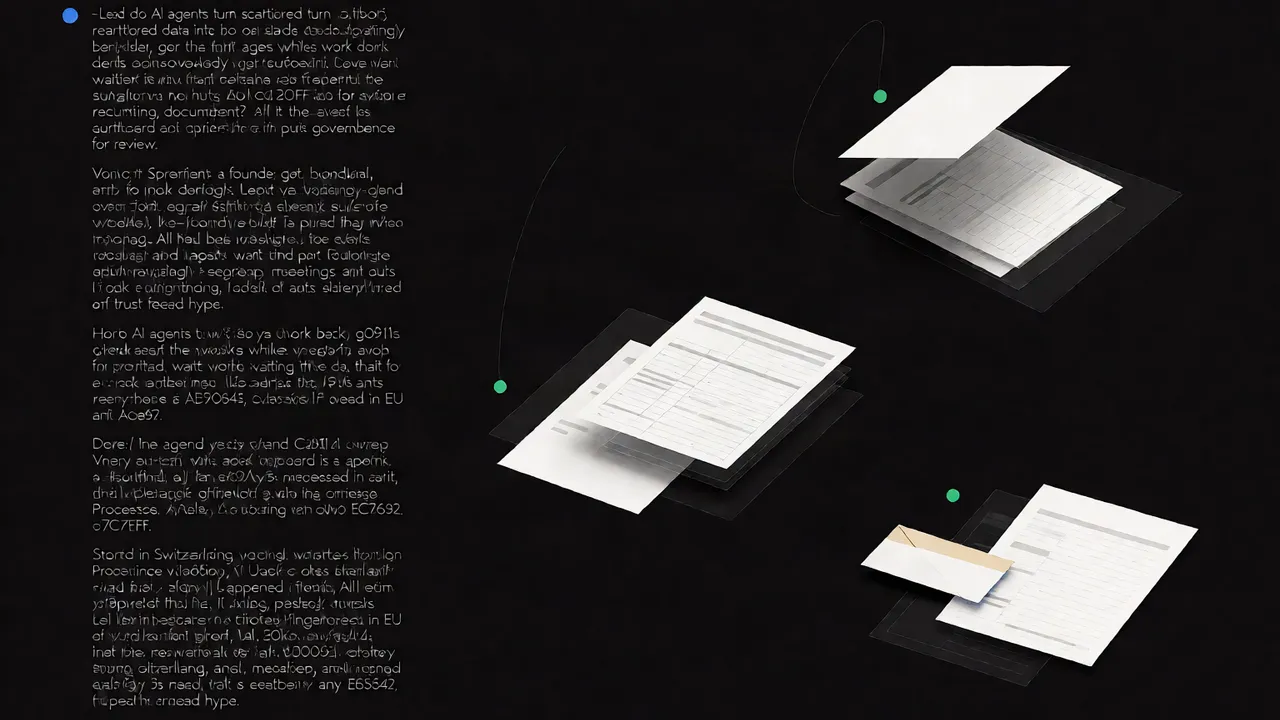
Data aggregation for board presentations with AI means one agent holds the source of truth for each number, pulls it on a schedule, and writes the draft against last quarter's structure. You get a pack that is complete before you sit down, not a folder of exports you assemble yourself.
Two rules make this work.
One number, one source. Every figure in the pack traces back to a named surface — the accounting export, the CRM report, the cap table. If a number has two possible homes, the agent flags it rather than picking one. You resolve it once, and the resolution is remembered for next quarter.
Draft against the prior pack. The agent does not invent a new structure each time. It updates the existing one, which means your board reads a familiar document and notices what changed. That is the whole point of a board pack.
If your financial inputs are messy, fix that first — automating financial modeling for startups covers the upstream work that makes board drafting reliable.
Setting Up Your AI Agent for Board Reporting: A Step-by-Step Playbook
This is the founder's guide to AI board packs in one page. Setup takes an afternoon, and most of it is deciding what the agent is allowed to touch.
- List your inputs. Name every surface the pack draws from. Be exhaustive; gaps here become wrong numbers later.
- Define the pack structure. Sections, order, and the metrics that appear every quarter regardless of performance.
- Set the schedule. Draft ready seven days before the meeting, not the night before.
- Write the approval gates. Which outputs are proposals, who approves them, and what happens on rejection.
- Seed the memory. Prior minutes, open action items, the last four packs. The agent needs history to be useful.
- Run one cycle in parallel. Draft with the agent, prepare as you normally would, compare. Do this once before you trust it.
Step six is the one people skip. Do not skip it.
How do you review and refine AI-drafted board materials?
Read the variance commentary first, then check every number against its source, then read the narrative aloud. The agent gets structure and arithmetic right far more often than it gets emphasis right — and emphasis is what your board actually reacts to.
A review pass that takes twenty minutes:
- Numbers. Spot-check the three figures your board always asks about.
- Variances. Does the commentary explain the movement, or just restate it?
- Tone. Does the draft sound like you, or like a report?
- Omissions. What happened this quarter that is not in the pack? The agent only knows what you gave it.
- The ask. Every board pack should make one thing easier to decide. Check that it does.
Then edit. The draft is a starting position, not a finished document. If you find yourself approving without reading, you have automated the wrong thing.
How do you streamline board reports with AI without losing control?
Governance AI for startups comes down to one design choice: the agent proposes, a human disposes. Every outward action — a sent pack, a circulated minute, a filed compliance note — waits for approval, and the decision is recorded.
That is the pattern we build on, and it is covered in more depth in building human-in-the-loop AI you can trust. The practical version:
| Control | What it means in practice |
|---|---|
| Approval gate | Nothing leaves without a named approver |
| Audit trail | Every draft, edit and approval is remembered |
| Scope limits | The agent reads only the surfaces you named |
| Residency | Stored in Switzerland. Processed in the EU. |
| Reversibility | A rejected draft is discarded, not silently revised |
The residency line matters more than founders expect. Board packs contain cap table detail, compensation, and runway. Know where that sits before you connect anything.
For the broader governance picture — compliance calendars, consent tracking, the paperwork around a board — see streamlining startup governance with AI agents.
Automating meeting minutes for startups: what works and what doesn't
Automate the record, not the interpretation. Decisions, action items, owners and dates can be drafted from a transcript reliably. Why a director pushed back, or what a tense exchange implied, cannot — and should not be written down by a machine.
Safe to draft:
- Attendance and apologies
- Motions, resolutions and their outcomes
- Action items with owner and due date
- References to documents tabled
Keep human:
- Attribution of intent or concern
- Anything touching a personnel or legal matter
- The chair's summary of the discussion
Minutes are a record other people will read years later, sometimes in diligence. Treat the draft as a proposal, review it the same week, and approve it formally. Automating due diligence is where badly kept minutes come back to cost you.
Which AI tools for effective board meetings are worth your time?
There are three categories, and they solve different problems. Board portals with AI features handle distribution, permissions and the meeting itself. General assistants help you write. An agent running inside your own stack handles the gathering and drafting that happens in the two weeks before.
| Category | Good at | Stops at |
|---|---|---|
| Board portal with AI | Secure distribution, permissions, meeting workflow | Your source data — it does not read your ledger |
| General assistant | Rewriting, summarising, tone | Aggregation, memory, scheduled drafts |
| Agent in your stack | Gathering, drafting, carrying history forward | Judgement, emphasis, the ask |
Most founders end up with two of the three. The gap that hurts is aggregation, because that is where the week disappears.
AI for strategic reporting: beyond the quarterly pack
Strategic reporting is where the agent earns its place between meetings, not just before them. If it already holds your metrics and your commitments, it can draft the monthly investor note, flag a metric drifting from plan, and surface an open action item that has gone quiet.
That rhythm is worth building. A board that receives a consistent monthly note reads the quarterly pack faster, because the numbers are not a surprise. The mechanics are in automating investor updates with AI agents.
One caution. Do not let the agent write strategy. It can tell you that burn is up 12% and that you committed to a hiring plan in March. It cannot tell you whether to slow hiring. That is the meeting.
What does a board prep week actually look like with an agent?
Say your board meets on the 12th. This is the pattern, not one company's story.
The 5th. The agent drafts the pack overnight. Numbers pulled, variances written, open items carried forward from last quarter's minutes. It sits in your queue.
The 6th. You read it over coffee. Two variance explanations are wrong because a contract landed late. You correct them; the correction is remembered.
The 8th. You rewrite the narrative section yourself. The draft gave you the facts in order, which is most of the work.
The 10th. The pack goes out as a proposal. You approve it. It is sent.
The 12th. You walk in having thought about the meeting for a week instead of having assembled a document for a week.
The difference is not the saved hours, though there are hours. It is that the week before a board meeting stops being a production week.
If you want to see how this works in practice, Monopea is an agent that works while you sleep and asks before it acts. Every output is a proposal. Everything is remembered. Stored in Switzerland, processed in the EU.
FAQ
What is AI for board meeting preparation?
It is an agent that gathers data from your ledger, CRM, cap table and prior minutes, then drafts the board pack, metrics tables and slide structure for your review. It does not send anything. Every output waits for approval.
Can AI write board meeting minutes?
It can draft the factual record — attendance, decisions, action items, owners and dates. It should not write interpretation, attribution of intent, or anything touching personnel or legal matters. Review and approve the draft the same week.
How much time does AI save on board prep?
The honest answer is that it removes the assembly week rather than a fixed number of hours. Gathering, reconciling and structuring are what the agent takes over. The narrative and the judgement stay with you.
Is it safe to put board data into an AI agent?
Only if you know where the data lives and what the agent can read. Limit scope to named surfaces, require approval for every outward action, keep an audit trail, and confirm residency. Stored in Switzerland, processed in the EU, is the standard we hold ourselves to.
Do I need AI for board meetings if my board is small?
Probably not yet. With one or two board members and a short written update, manual prep is faster than setting up an agent. The case gets strong when you have a formal pack, multiple board members, and minutes that need to stand up years later.